NB Oslofjord – testing nature-based solutions
NB Oslofjorden is trialling nature-based restoration measures with the aim of promoting marine life and improving the condition of the Oslofjord.
- Project period
- -
- Funders
- Sparebankstiftelsen
- Research section
- Marine biology
- Contact persons
-
 Eli Rinde
About the project
The aim of the project is, through joint and coordinated efforts amongst stakeholders involved in small-scale restoration initiatives, to test solutions and gain knowledge about which solutions work where, so that the initiatives can be coordinated within an overarching and holistic plan for how they can be used to promote marine life in the fjord.
We will investigate whether combining different measures can have positive knock-on effects for biodiversity. Can we achieve greater benefits from a combination of measures than from each measure individually? Is there synergy between the measures, such that they promote greater biodiversity than they would if implemented individually, and is it possible to achieve positive cascade effects? Can the measures be used to create connectivity between isolated areas and fragmented habitats? We also wish to test the effect of various measures, both in combination with and without local conservation measures such as lobster sanctuaries and no-fishing zones.
The project is led by NIVA.
The project’s partners are:
The Nature Conservation Association of Oslo and Akershus
The City Environment Agency, Oslo Municipality
The Oslo Bathing Association is providing venues, and the Norwegian Environment Agency, Akershus County Council and BYM are participating in the project’s reference group.
This is how the project is organised
Work Package 1: Organisation, planning and design for testing
The aim of AP1 is to ensure the effective planning, coordination and implementation of the project’s activities, and to ensure that the various measures are tested in a scientific and verifiable manner.
Work package 2: Regulation and dialogue with the authorities
The aim of AP2 is to ensure the lawful establishment of sites for testing the synergistic effects of various types of small-scale initiatives, through dialogue with the relevant authorities and by applying for the necessary permits.
Work Package 3: Development and design of new measures
AP3 focuses on developing new restoration measures and solutions for the sustainable and circular use of materials. The latter involves developing solutions for the use of harvested biomass. The development of innovative solutions is necessary in order to arrive at site-specific restoration measures and to be able to scale up these measures. It is particularly important to develop materials that are more marine-life-friendly than those currently in use.
Work package 4: Testing and monitoring of existing and new measures
The aim of AP4 is to test and monitor the effects of the restoration measures developed and refined through the activities carried out in AP1 to AP3.
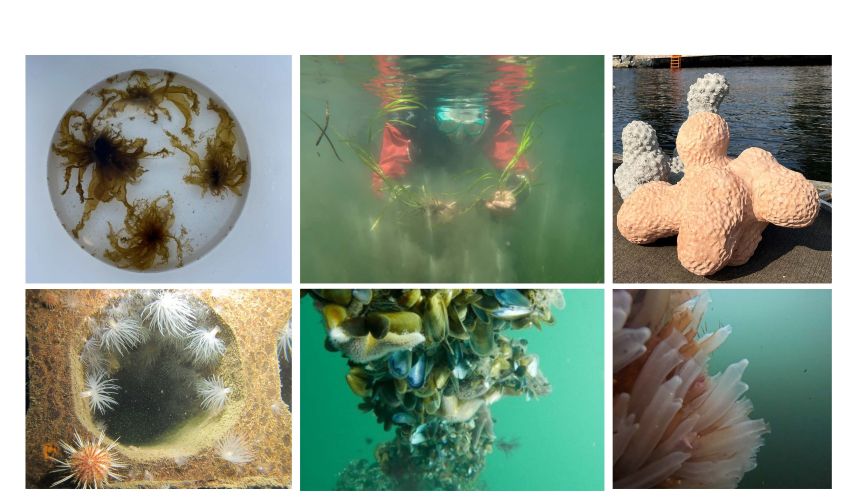
The work builds on experience from previous pilot projects and will contribute to knowledge regarding implementation, choice of materials, interactions between measures, optimisation of growth conditions in an urban environment, and development over time (both in terms of biomass for eelgrass, kelp, mussels and tunicates, and in terms of associated small-animal diversity).
The measures include methods relevant to both the restoration of habitat types (such as eelgrass beds and sugar kelp forests) and other nature-enhancing measures.
A key objective of the measures is to promote and increase knowledge of the fjord’s small invertebrates. These convert algae and organic matter into food for species higher up the food chain, and thus play a central role in restoring the ecological balance of the ecosystem.
Work Package 5: Dissemination
NB Oslofjorden’s communication work demonstrates how restoration measures can help improve the condition of the Oslofjord, generate engagement and show how people can support or take part in the work
Communication should be positive, inspiring and knowledge-based. Our primary target audience is everyone who lives in or travels around the Oslofjord. More specifically, we have identified our secondary target audiences as:
- Children and young people (including families with children)
- People with strong ties to the fjord (fishermen, boating clubs and outdoor enthusiasts) o Decision-makers and public authorities
Our core message is that restoration makes a difference, that the Oslo Fjord is a shared resource that we must look after together, and that everyone can contribute. We aim to include research and researchers in all our initiatives, tailored in an appropriate manner.
.png)