
- Project period
- -
- Funders
- Horisont Europa
- External webpages
- bggovernance.eu
- Research section
- Water and society
 Gunnar Sander
 Caroline Enge
 Saskia Trubbach
 Mari Susanne Solerød
 Cecilie Baann
 Line Johanne Barkved
 Silje Graffer
About the project
The main goal of BlueGreen Governance (BGG) is to:
- Develop innovative land-sea governance schemes based on scientific evidence and societal choices that link marine policies with the management of the land and inland waters;
- And draw lessons on how to trigger and facilitate institutional change and policy reforms for better marine policies
Background
The current management of oceans, seas and coasts is fragmented across multiple institutional layers and policy areas, and based on past experience. BGG pursues an innovative approach to the governance of the seas and coastal areas that:
- romotes integration between institutional layers & across policy sectors with a clear impact on the use of the land and the sea;
- Involves and engages citizens in decision making processes, while at the same time including scientific evidence;
- Responds predictively to changing physical conditions as indicated by scientific evidence on major environmental challenges as well as indigenous and local knowledge & citizen science
- And uses e-governance tools in support of the previous three points
With this focus and approach, the project responds to the need for better-informed decision-making processes, social engagement and digital innovation while promoting more harmonious and effective science-policy-society interfaces.
The promotion of better science-policy, science-society and society-policy interactions will be embedded in the digital transformation and application of egovernance tools for codesign and service delivery.
Approach and case studies
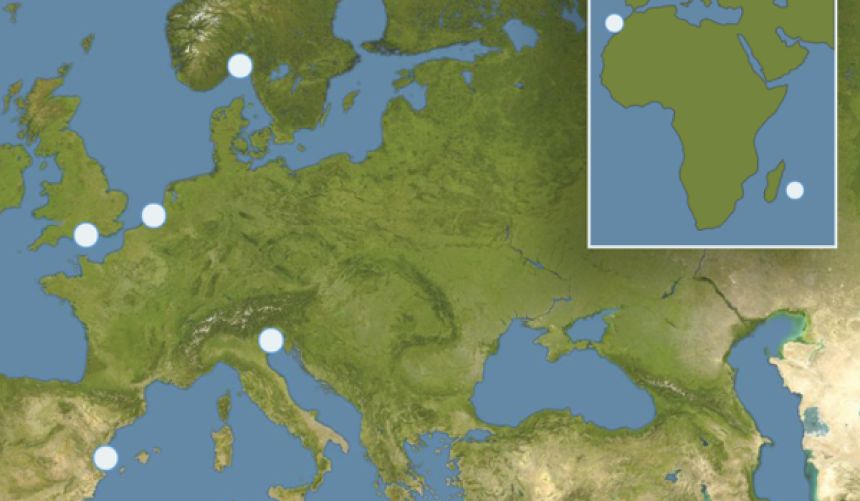
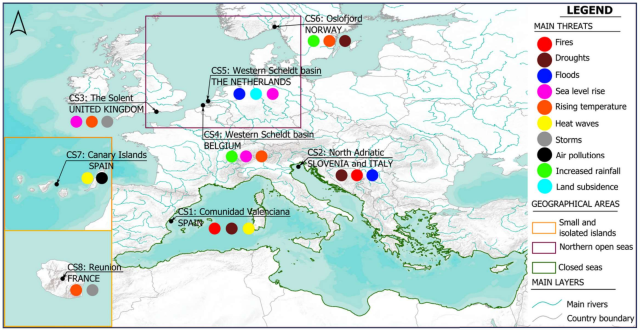
BGG will implement and assess these innovative governance schemes in 8 cases across several European regions and sea basins and will draw lessons on how to trigger and facilitate effective institutional change via capacity building.
The cases are:
- Comunidad Valenciana
- North Adriatic
- Isle of Wight
- Western Scheldt
- Oslofjord
- Canary Islands
- Reunion.
With this geographical scope, the project will investigate five marine basins (Western Mediterranean Sea, Eastern Mediterranean Sea, North Sea, Atlantic Ocean and Indian Ocean), including one transnational marine basin (i.e. the North Adriatic case) and one transnational river basin (i.e. the Western Scheldt case).
Om Oslofjorden
The Oslofjord is currently facing a severe ecological crisis after decades of intensive human use. Despite earlier improvements in reducing industrial pollution and sewage discharges, the fjord continues to suffer from eutrophication, declining fish stocks, biodiversity loss, and reduced public access to coastal areas. Climate change further intensifies these pressures through rising water temperatures, heavier rainfall, and increased nutrient runoff.
The case study focuses on how governance systems can better address these interconnected land-sea challenges across the entire fjord catchment.
Problem statement:
The main challenge in the Oslofjord is not only environmental degradation, but also fragmented governance. Existing River Basin Management Plans under the Water Framework Directive are too limited in scope, focusing mainly on pollution while failing to fully integrate fisheries, land-use planning, recreation, and biodiversity protection. Multiple sectors—agriculture, wastewater, fisheries, transport, and coastal development—create cumulative pressures, but responsibilities remain divided across institutions and governance levels. This makes coordinated action difficult and slows the transition toward effective ecosystem-based management.
Impact:
The Oslofjord case demonstrates how ecological restoration depends on governance innovation as much as on technical measures. The 2021 Oslofjord Action Plan created a new cross-sectoral governance layer that includes 118 municipalities and introduces stronger coordination through the Oslofjord Council. This has increased political attention, improved cooperation between sectors, and strengthened recognition of land-sea interactions. At the same time, challenges remain around stakeholder participation, funding, climate adaptation, and the need for clearer measurable goals. The case shows that long-term recovery requires both institutional reform and sustained public support.
 |

|
 |